NAU NUA DECEMBER 2010


SUMMARY

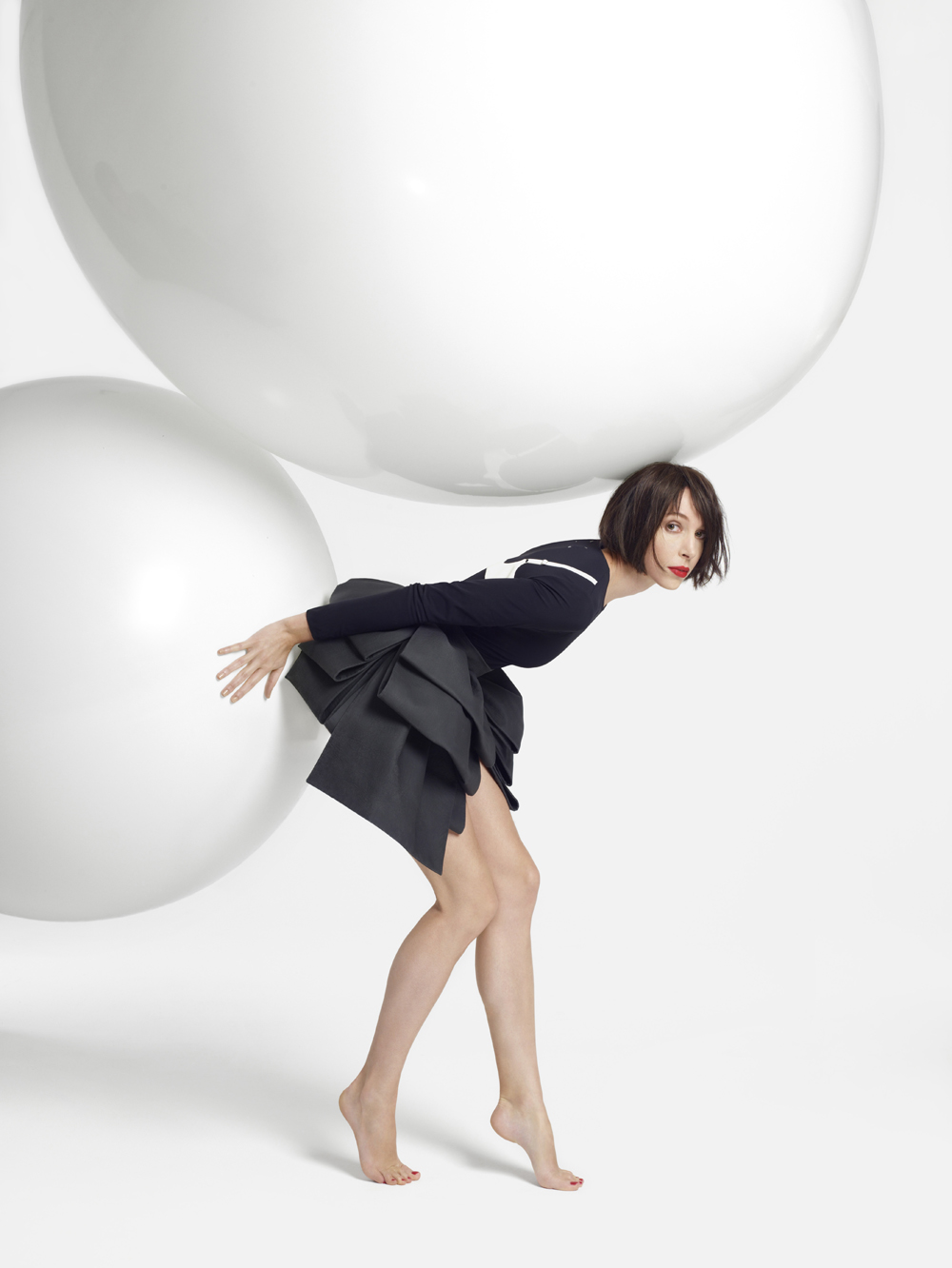
FRONT COVER    Vilde Stedal Kalvik. Attitude

HOM

Jeanne Cherhal. Charade
The limit as a beginning


NAU

Richard Galliano. Bach
According to Bach


Melancholy Maaret. Nora Helmer's daughter
Hedgehog's shadows


Sophie Bancroft. Bird of paradise
A way to escape


Zola Jesus. Stridulum II
Talking with the sea


Woo Ming Jin. Woman on fire looks for water
The need's trap


Mooi. Apple Cherry Plum
Sonorous fruits


NUA

 José María Nunes
Wine's nocturne


ENVERS

Hollace M. Metzger
Time is a willow


Olivia Adriaco. Heaven Seven
Desire's colour


Clara Engel. Secret Beasts
Undressing the instinct


Kat Boelskov. Amateur
Free love


ESBÓS

Hollace M. Metzger
Paintings


Vilde Stedal Kalvik
Thruthful details


Derek Moench
Autumn Re-imagined


Gala knörr
London Fields


Kayla Marie Craig
BORN

FECINEMA
12 Festival de Cinema Negre de Manresa

JEANNE CHERHAL


The limit as a beginning


En toute amitié tu as relativement envie d’être mon amant pour ce soir... Jeanne Cherhal returns with her third studio album, Charade (Barclay, 2010), offering us eleven songs with a common thread: a charade into four parts . It’s a very personal work in which Jeanne reveals her passionate and rational thoughts always in a continuous struggle. From that struggle is born a sound in which she plays all the instruments. She sings Mon corps est une cage as a passionate stimulus. So, she decided to isolate herself for a year in the studio in order to create and record. The limits are a starting point, never and ending one.

Isolation may lead her to magnify her impulses but the feeling is that it is a consequence of them. The need to assimilate what she has lived to the full and to return to the desire’s ring in order to fight with renovated forces against the absurd walls. Je t'appelles dans la nuit, même au-delà de minuit tu réponds, je te dis "je suis perdue" et tu me guides par les rues et les ponts. Jeanne satirizes the contradictions between desire and engagement. En toute amitié starts howling with a firm rhythm, the excitement in the middle of the night turns on a vigorous piano which is followed by the other instruments. Everything goes in crescendo through sighs and gels car amitié comme ça car c'est sacré.

Plus rien me fera mal
sounds more like a wish than a reality. Jeanne sings fragile to the wounds suffered. The piano sounds fearful while she longs for sous le ciel trop doux plus rien me fera mal. But she knows very well that never will because life is a losing hand. Mon corp est une cage brings us the origin of suffering. She falls in a lack of communication because the misunderstood boundaries. Also, the lack of curiosity and enthusiasm for the game lead us to reject what doesn’t respond in the way we want to. Passion is a skill that few people have and few people can recognize. The forms are a beginning to create new questions over the other and not a place to hide us. To love someone is to want to discover him being also open to be discovered. Mon corp est une cage qui m’empêche de danser avec l’homme que j’aime et moi seule ai la cléf. And the limit determines us to the silence.


Reviens-moi, marche dans mes pas sung in a tremendously evocative tune. The notes flow like the waves of a whimsical and almost inconsistent sea. She abandons herself to her one desire and claims the possible origin of her isolation to return. And we all stay facing the sea with arms folded without being aware that every second counts.


Text by Juan Carlos Romero
Photos by Tania et Vincent

RICHARD GALLIANO


According to Bach


42 Festival Internacional de Jazz de Barcelona


The recent path of the great French accordionist Richard Galliano can be seen as a homecoming. Johann Sebastian Bach was a German composer, organist and violinist who brought Baroque music to new heights of maturity, creating the foundation of all music that emerged later. Indeed, everything is in Bach, and Richard Galliano has been immersed in his work with the quintet of classical musicians who accompanied him in his inspired reading of the work of one of the greatest composers of the last century, Astor Piazzolla. Listening to Galliano’s latest work is as a return to the source.

The Festival International de Jazz de Barcelona put the Palau de la Música Catalana’s stage at Richard Galliano’s feet for the admiration of the audience. That concert was on last 19th November and Galliano presented his recent Bach (Deutsche Grammophon, 2010) with some pieces from his project Piazzolla Forever (Dreyfus Jazz, 2003). The pulse from vigorous to derivatively contemplative Piazzolla’s compositions resounded along with the harmonies emerged from the compulsive and wonderful Bach’s composition. Erik Satie was also present in one of the most chiaroscuro moments of the night. All this happened under the Galliano’s enormous inspiration on accordion accompanied by a magnificent classic performing quintet: Jean-Marc Phillips on violin, Sébastien Surel on violin, Jean-Marc Apap on viola, Raphaël Pidoux on cello, and Stéphane Logerot on double bass. The concert ended with the audience standing up completely delivered to that French musician. He could hear some ardent bravos when he played solo the ending piece.

His interpretation of Bach's work is truly sublime. Galliano approaches the classic composer from a naturalness given by its high musical sensitivity. In his own words "en effet, dans ce disque, j'ai choisi un répertoire destiné à une multitude d'instruments (le Violon, le Violoncelle, les Claviers, l'Orgue, le Hautbois...) et chaque fois l'Accordéon, le Bandonéon ou l'Accordina (sorte d' Harmonica à boutons) s'approprient la partition originale et démontrent l'universalité de la Musique de J.S. Bach, pouvant être interprétée de manière tout aussi artistique et expressive sur des instruments inventés quelques... deux siècles après la mort du compositeur". And that naturalness is deeply perceived by the audience soul in his concerts but also in his records. His music always flows as it was emerged for the first time. It's new and old, it’s the return of everything we once knew and had forgotten. But Bach's music is always waiting in the path of creative memory.

The accordion and bandoneon road through the melodies of Bach’s compositions is ultimately delicious. Badinerie (suite for orchestra No. 2 in B minor) through the most popular Air (Suite for Orchestra No. 3 in D major) to his unique original composition, Aria, a tribute to the legacy of the master, are signs that all makes sense in the sensitivity.


Text by Juan Carlos Romero
Photos by Emmanuel Ducoulombier

MELANCHOLY MAARET (SECRET SAUNA SIRENS)


Hedgehog's shadows


Melancholy Maaret states in her website that "Tarkovsky's polaroids Are Better Than asteroids" which is already a strong statement of visual and poetic principles. To penetrate her universe leads us to hermetic feelings, almost suffocating. Shadows and grey shades are here the framework for our existential traumas carried since our childhood. Alice felt as a wonder a world fruit of the passage of the darkest dreams and desires, where the strict social norms appear blatantly ridiculous and hurtful with impunity. Melancholy runs through this passage and creates a world of sirens that belong to the secret sauna we all have inside. Poet, photographer, video artist, has an insatiable need to show our hidden corners, which are also yours.

Nora Helmer's daughter is a work in which Maaret shows us the bones of the lie between a mother and her daughter. It is the fifth piece in the series Naive ComputerOpera for Heroine and Hedgehog, video-poetry project that includes music and visual installations whose last creative phase will use the live movement. "Each story can exist on its own, and every story also is a russian doll, breathing inside the other stories". Thus, Maaret invites us to discover layers in her work but also in our own soul.


Initially, the negative image of a hedgehog illustrates Maaret’s voice, here the daughter of Nora Helmer, whispering Mamma ... I pretend to be you. The dreams and desires of mother and daughter are here confronted in the daughter’s whisper, seeking the border between their existences, and individuality becomes a distant goal for both of them since the same birth. What do you become, mamma? Are you an artist like me? The daughter walks through her own vision of her mother again and again wondering about their own identity. You're an oil painting, I am the sea, old lady, you cannot love anyone, your own heart in a nutcracker ... One senses the idea of the mother creating the daughter beyond her birth, trying to influence on her identity which always becomes something impossible and is painful because that attempt never results innocuous. The video shades are streaming from the grey to blue, green, red and pink pastel, in a blurred air, not too much defined. The images are purely domestic objects seen as a prison, not as freedom spaces. Now is the time for the child breaks that chain the mother also suffered with their parents. The quintessence of life is grace over perdition ... The ghosts created by traditional beliefs and customs, all the resignations early assumed because our desire of being socially accepted and then imposed to our children because our lack courage in life.


Text by Juan Carlos Romero
Photo and video by Melancholy Maaret (Secret Sauna Sirens)

SOPHIE BANCROFT

A way to escape


Bird of Paradise (LisaLeo Records, 2010) fills a lot of spaces. In our ordinary life we create holes inside us that we abandon just because our cowardice.  It was the same situation as kids when we got scolded, we use to negate those spaces, which are really necessaries, just to not accept our fault. Maybe, we’re selling a little bit of our souls every day to the devil we all have inside just for nothing else than a poor smoke, and that means nothing. Is there something else? Yes, there are birds so free that we are unable to recognize them. There are flights over the paradise.

There’s veins of hope in broken things, see my blood re-inflate his wings, I’ll kiss him like a wasp sting and shock him into loving me. A guitar pizzicato precedes the beautiful voice of Sophie Bancroft in the song Occasional China in which she stops in every detail of her beloved. The viola’s solo really thrills giving us the fragility feeling of the never said words that build spaces on the verge of a break up. But tenderness appears in I carried your heart, a personal song by Sophie. Her intonation is so warm telling us time passes by, the earth turns completely around once every day…and still I can see from my front door the same piece of sky. But it’s any piece of sky, it’s the blue that accompanies her each year, the shoulder where she rested so many tired looks and created so many questions fed on her own lights, shadows and silences. That piece of sky will always be with her, wherever she is.

Whispers are important when they arrived loaded down with truth and no need in the love to the other disguise. No smokin’ just accepts the need that admits the bitterness and the egoism with no disguises. I’m waitin’ on you to light me again, I’m waitin’ to you to ignite me again, I need you to drink my musty tears, I need you to light my cigarette, I need you to tell me you’ll always be here. Then, to admit it is to love it.

Again, Sophie in her own words and music brings intensity to her acoustic guitar in the title song of the album. I am a window cleaner, cleaning the people’s eyes, I am a bird of Paradise. Conformism is not enough when she has a deep curiosity living inside her to the full. 
Her voice gets away, she wants to fly beyond her kitchen’s walls. She talks to them in an inert way. They never answer like her piece of sky does because her mind is in a magical and mysterious journey, full of walrus and fools hills.

That feeling is more painful when the geese fly south, feel lost and lonely here, your dreams of yesterday surround me as they fall in dusty silence. Everything is fragile and fearful even at home, but there when I cover my ears I still hear your song and with eyes wide shut I see where I belong and I know that I am home. If we all closed our eyes, her voice would take us back home and we would meet again our piece of blue sky. Just the way she already did it in her previous album Handwritten (2008).


Text by Juan Carlos Romero
Photo courtesy of Sophie Bancroft

ZOLA JESUS

Talking with the sea


Festival Primavera Club 2010 Barcelona


The concert began in a cold way. Few people attended the concert in Barcelona’s Sala Apolo. Festivals have always tight programs and they are always hard to follow. Festival Primavera Club was in that case. I admit I felt fine knowing that I could enjoy Zola Jesus music in a comfortable way. Zola Jesus is the alter ego of the American singer Nika Roza Danilova. She’s just twenty one and radiates a powerful voice surrounded by a gothic and icy atmosphere. The sea talks to us through her music and one feels it very closer although its remoteness. The sea brings us dense fogs and red sunsets and returns to us the echo of every tear we’ve shed on it.

Deservedly, the ambient became heated by the third song. A lot of people were late but in time to fall in love with the overwhelming voice of Zola Jesus. A minimalist ambient on stage in forms and sounds shows her vocal and melodic power. Last year has been a really splendid one: she has published three records and has performed in ninety seven concerts sharing stage with bands like Fever Ray. Her recent album Stridulum II (Sacred Bones Records, 2010) gives us creativity in a bizarre aesthetics and a heartrending content.

I can’t stand starts with the lament it’s not easy to fall in love. Nothing has been easy to her but the fact is that her frenetic activity makes sense to the following sentence it’s gonna be alright. The drums in a martial rhythm reminds me Sunday, bloody Sunday by U2, but they are here following a more painful voice and firm step. Life is not easy but is full of beauty beyond the insubstantial oversimplification.

Listening to Poor animal one feels that the sun is rising just for you. The keyboards blend our personal skies. Each mind travels alone through their sounds. I’m not your savior, save me please, we’re delusional poor animal. Yes, the sun rises but reality is still as hard as it always was and we just can count on ourselves.

Night is a highlight in the album. Don’t be afraid, in the end of the night you’re in my arms. But it’s always difficult to face up the fears that are waiting for us when we leave the ordinary bus. So come close, close to me and I’ll come closer to you. Even so its sound reminds us the solitude’s impotence. When you’re lost never look down, when you’re lost know I’ll be around, in the meantime when you are found I’ll be here. Nobody can find us although it’s always helpful a lighthouse through the night. It’s a masterpiece.

Heaven can wait the better portraits of our fears in Nika’s songs despite the risk of showing oneself up. Her Sea talk already stresses I can’t give you what you need.


Text by Juan Carlos Romero
Photo 1 by Dani Canto
Photo 2 courtesy of Primavera Sound

WOO MING JIN

The need's trap


L'Alternativa 2010
Festival de Cinema Independent de Barcelona


Woo Ming Jin is a young filmmaker born in Malaysia. He has studied cinema and television in San Diego, USA. His short career has already attracted attention to many film festivals around the world with films like Monday morning glory (2005), The elephant and the sea (2007) and The tiger factory (2010), his last film just after the one presented in the official section of L’Alternativa 2010 Festival de Cinema Independent de Barcelona.

Woman on fire looks for water (2009) shows marriage as an economic solution. Living together for love or for economic interest is the dilemma presented here by the different experiences lived by a father and his son, they both linked with the fishing business. While the young son is trapped between the beloved girl and a rich businessman daughter’s desires, the father sets out to look for the beloved woman he rejected a long ago just for the money. The film becomes a thriller for the audience because the son is falling down in the same mistake the father has been paying the whole life. Now, as an older man, he tries to rectify it but perhaps it’s too late.

The film goes from the rawness of their terrible working conditions to the precious nature that gives us images in intense green shades and skies full of nuances that seems to be a metaphor of the richness of our existence which we use to reject due to the fear of an inexistent future. Water is also important as a way of life and source of food, but also as a symbol of the feelings and interests flow. The river baths the green it has created with a lot of efforts.

Part of a very remarkable official section complemented by varied program of parallel sections and tributes to Alexander Kluge and José María Nunes, that film became a highlight in L’Alternativa thanks to a very personal touch. The film has also been presented in some important festivals such as the Rotterdam and San Francisco ones. We just call future to the mirror of our fears and we become trapped in and lose the green horizon of the present moment which is already past.


Text by Juan Carlos Romero
Photo by Woo Ming Jin courtesy of L'Alternativa

MOOI

Sonorous fruits


Mooi means pretty in Dutch but her music comes from the Mexican land. Mooi is in her own words an apple sweet like a cherry, sometimes in sorrow like a plum but in the end it’s all good like a watermelon. But she creates images that are evocations beyond the earthly fruits, they are a land for dreaming.


Mooi is a recent project born from the experimental composition of Renée Mooi, the production of Gunther and the electronic sounds of Diego Quirós. Together, they have created an electronic pop sound ready to catch us. Renée sings in English with a suggestive voice weaving dense sounds but dreamy, as she says un gran ejemplo de lo que puede resultar al lograr lo complejo de lo simple.

Apple’s first notes sound like this although they are also disturbing. Suddenly, some drops are sounding in the middle of the darkness before Mooi’s voice calls us from a long distance. Oh, why, tell me why you have a heart like mine inside and why you grow in trees…It’s very close to the Hamlet’s wondering to be or not to be just changing the skull for an apple. While the reasons resound the music becomes richer around the piano’s pounding because it’s always raining inside us.

A sinister atmosphere takes over Cherry although Mooi brings some light quickly. A subtle and beautiful piano tune calms us down after a dark beginning but dangers are still there. Programming and distorted sounds appear and disappear while Mooi sings her personal cherry taste. Moments are eternal even when they are dead.

Memories hit our minds when they are not solved. Plum’s sound is bittersweet but very rich in its mix of eastern and western sounds. When she sings I remember it’s like a mantra which is dead before its birth. Probably she can’t remember but she wishes to. The strings section surrounds a dream created from desperation.
All those tastes get mixed with memories and fears of an uncertain future. But Mooi moves forward with a firm step and an elegant creativity.


Text by Juan Carlos Romero
Photo courtesy of Renée Mooi

JOSÉ MARÍA NUNES


Wine's nocturne


L'Alternativa 2010
Festival de Cinema Independent de Barcelona
“Ahora es siempre, el siempre de antes y de después, sin relojes ni calendarios. La existencia es la realidad, la verdad es la vida. Esto es más o menos el arte”. That’s a brief extract from the José María Nunes speech for the Second Artistic World Meeting in Valencia in 2002. He was an eccentric filmmaker and had image as his main language because he doubted his speaking ability and for that reason his speech were always very long and halting. His ideas were always an incessant ray the same as his films. He died on 23rd march 2010 just after the premiere of his last work, Res pública (2009).

He was born in 1930 in Faro, Portugal. He moved to Spain at twelve. First, he lived in Sevilla and later in Barcelona sharing a shack with his family in the early years. He began working in the cinema industry as an extra and later as a script. Subsequently, he achieved a job as a scriptwriter and director’s assistant and finally he got the direction of his first film, Mañana… (1957). “Tomorrow” is in his own words “la salida que buscan para engañarse a sí mismos quienes sienten la impotencia, la cobardía de afrontar cara a cara su circunstancia en la vida”. It was a real Nouvelle Vague’s preview in a Spain dominated by Franco and fascism. Even so, the film didn’t work because a bad working conditions but it spread the Escuela de Barcelona followed by filmmakers like Jordà, Aranda, Suárez, Camino or Portabella. Nunes thought that the cinema born from that group is the only real avant-garde cinema made in Spain ever.

His career achieved his highlight with Noche de vino tinto (1966), a night where two solitudes met and decided to go around every bar in Barcelona looking for a red wine’s heaven and ending in a grey rising without any hope. Then, Nunes experimented with filming without a previous script. But the Spanish censorship didn’t let him a way to do it so he decided to move to Paris in the final sixties. Freedom was always his way and he just returned to Spain with it and for it.

His last film, Res pública, is a reflection on existence as an individual fact. According to Nunes, each person can decide his freedom therefore his death. Since the birth, a person can decide between to live or to die at each moment. The film’s main role is a rebel who looks for a freedom he finally just achieves thanks to love some women or to irony and a subtle sense of humour. It’s a philosophy as well as his filmic chant A la soledad (2007) in which Nunes looks for the age of the sun as the higher level of intelligence. His search was his life.


Text by Juan Carlos Romero
Photo by Sílvia Subirós courtesy of L'Alternativa

HOLLACE M. METZGER

  •                                                                                             CATALÀ
  • ENGLISH
  • ESPAÑOL
  • MENU

Time is a willow


Hollace M. Metzger has held guest appearances in three music albums to be released in 2011. She’s a lover of time and space because they are movement. She has exhibited her art in New York, Ohio, Kentucky, Brooklyn and Paris. She has a magnificent intellectual energy expressed in painting, poetry, music and architecture. After her recent poems published under the title Why the willow (2010) she’s now working on her first solo exhibition in Paris. Many projects that take her to new visions, new words full of new meanings and new sounds to understand the past and wonder about the present.


You are an architect, visual artist and poet, always searching new ways for expression. Where does your artistic impulse come from and where does it take you to?

It comes from the necessity to communicate and, more importantly, to exist in time. I suppose it also comes from an incessant need to be organized – order, geometry, finding modulars, you name it! In photography, I think I’m drawn towards moments where a person may be inspired to make a decision whether its about gravity, direction to travel... which is also symbolic to many questions in life. I do seek symbolism in photographs as well, more so making those symbols new symbols that could mean something personally, not quite as powerful as Van Eyck’s  Arnolfini. In painting, I leave realism to the experts as what I feel driven to find are new methods, new perspectives of what could be perceived on a cellular level, a microcosm, an urban plan or even a universe. It also connects to rhythm, why I often paint to music, and try to extract from my subconscious. What matters to me most is that it works well together, that its rhythm creates or reacts to other rhythms and – whatever form it may take – it’s resultant beauty lies in the fact that all components need to exist while vibrating off of other bodies, masses, forces and energies. Where it takes me is a surprise every time, but I know every new work results in me knowing myself better.

You completed your degree study with a thesis called “Kin-Aesthetic Fourth Dimension” and you’ve mentioned it as a life-study where you proposed architecture, experience and painting as a combined practice. Could you tell us the main idea behind your thesis?

My undergraduate thesis, yes. Kinetics, Aesthetics and Time remain important in my work. There is a long list of renowned architects who also painted and instead of this being extracurricular, it was necessary in their studies of space. I watched this dwindling since 3D became standard visualization around 2000, for selling, and now I feel tangible discovery is something lost in today’s professional world.  You can also see this with youth and video games.
Furthermore, my study involves what something appears to be, what we as humans are attracted to follow out of curiosity and this motivating our mobility, to move through and interact with space and objects defining space, becoming a part of it. Again, its the question posed (confrontation with planar objects, void, etc.) that results in a decision, thus incorporating human psychology into the mix as well.
I think a brief review of Cubism and Futurism would explain what I mean about objects in space over a time sequence. When there are represented start-points and end-point in a path of movement, one often looks between to understand the story, and this “between” represents a specific time frame. Diagrammatically, you can see this in the vesica pisces for example, what is shared among those experiences. This may be specific, but formal connectivity, fluidity, is what interested me in art and eventually led to thinking of it on a greater scale, as in one’s life and the natural transformation of self.

Transparency is a recurring concept in your works, from your thesis to your poetry and the poem “For I, Wish” is a perfect example of that: “Sight unseen, these dreams lead to transparent heavenly lights cusping ever-present darkness in opacity, to night-time’s rooms without walls -On the edge of day and night, to remain, always. For I wish to be still from this distance, with the possibility of traversing boundaries when need be, or traveling, sidling its circumference where I will see only totality, all forests for trees.” Do you think we all have a strictly materialist life’s concept and perception?

I think the evolution of transparency in my work is rooted in a desire for truth, as in poetry disclosing many truths of an author even if they are not blatantly stated. “Sidling (a) circumference” represents a personal desire to maintain a good view of the whole, to never fall comfortably into one classification or train of thought while remaining open-minded. 
Transparency also allows us to reflect backwards and forward in time, both of which I am a proponent. More importantly, it allows for these views while understanding and celebrating where we are now. The mysteriousness , or “translucency”, of what lies ahead keeps me moving forward while what lies in the midst, memory, becomes more and more hazed-over.
I think this is also why I’m opposed to digital alterations in documenting a place. By bending low, looking backwards, reflecting... perhaps others will have the inspiration to see differently, appreciating life more while also realizing they don’t need to leave the natural world in order to do it. Either he/she needs to have a different perspective of life or, simply, move a little bit.
Regarding materialism, I think trends have pushed humanity into its comfortable loft embracing its social adaptations with silk pillows. Unless we change our attraction to it, cease applause for those who do and realize what is most important in life, we will continue to devalue it with more and more “things”. I think man is a collector and this does make him lovely., but when that collection begins to contain objects that are not really his, just to compare his curio cabinet with another, then I don’t really understand the point of it.

Another of your poems, “In passing”, ends with a deep reflection about love and life as poetry in passing. Is real love present in ordinary life?

This particular poem is time-specific and situational. I’m often documenting moments that have happened, emotions that may or may not come again. If I have a list of every possible emotion in the end, then I will consider it all a success, not necessarily for me but for others. Thinking why I read books... so that others may read and say, “Yeah, I know what she’s talking about...” Then, smile or not feel as if they are an island. I think society loves as it has learned to love, or how it has adapted to respond to such sentiment in their brain. So, yes, I think man loves. I am not so confident he or she will always express it in a way where any other will understand. And this is why it was “passing”. It was another personal relationship with another where communicative love just wasn’t possible, my realization of it. This poem was also written when a close relative had died, so I paralleled the two and ended it by saying that a life, a love, will be – at the conclusion of the poem – passed. And it was.

For if you decide not to exist, do not invite me into your life. Do not falsify your ability to love, to live, to learn, to give.” It’s an extract from your poem “No other way”. Is society based on false premises created by beings jailed by their own fears?

Yes. Well, it’s not so simple really, but my opinion is: I do feel many beings are jailed by their own fears in addition to learned sociology – aged children in adult skin, if you will. If we could negate both, I think we could progress as a more unified world. However, I now know I cannot blame someone for being all they know to be, but I’ve said my peace before I walked away and that’s what a lot of my intimate poetry is about. Perhaps then, the person I am speaking to and others will at least think about it and make a different decision from their own logic and experience, which would be the “Other Way”. I think its also important to appreciate every “new day” for what it is – never anything that has happened before. That day can bring proof that previous fears should be no longer, that anything could be seen differently.

Is life full of boundaries that restrict our existence or an open space to discover?

I think my friends and family would say that I am not the person to ask this question to.
I am as stubborn as they come, when I believe there is an answer somewhere or that an obstacle can be overcome. Yes, life is full of many, many boundaries. Where to not find the fissure that cannot be traversed on earth, or how to learn a new way to jump it is yet to be determined. I also have found that intimidation and a lack of drive is the greatest enemy to most – not the actual obstacle. Our existence is only restricted in our lack of belief in ourselves. There remain open spaces to discover, perhaps they just take form as something we did not expect or predetermine from studying a textbook.

Why the willow?

Because it may appear saddened, yet I was offering a new viewpoint: Perhaps it is reflecting in its own tears to see its own beauty and the beauty in detail, of the things around it which serve as its seasonally-changing backdrop and in it’s life-composition. This is explained in the conclusion of the poem. I think it was my way to say to readers (as poets, romantics, creatives, empaths, etc. are often categorized to be melancholic) to take another look at what they see, categorize, or write off. Life isn’t so easy and there are beautiful souls to befriend, to know. However, they may not be fully bloomed, erect, or bearing fruit!
This was the last poem written – when asking myself a very personal question – which, wherever the pen wanted to take me on that day, would also be the title of the book.
It also reconnected the text to my art, what I was focusing on that year in photographs and painting, even architecture – “reflecting”, a lack of gravity and possible euphoria in a state of “weightlessness”. There are of course many biological and reproductive details about the tree that attracted me to it, but mainly it was because of its stature., symbolically. Other poems in the book also reference youth passing and maturity which were on my mind as well.

What’s beauty?

One thing I’ve learned is that one’s definition of beauty changes over time. I think beauty is truth, honesty, sensitivity – making the most of a person’s, object’s, place’s or idea’s content. I think it is taking primary colors and discovering what can be made with them, metaphorically speaking. Beauty can be found in anything, but it is our responsibility to observe it from afar, in totality, or closely under a microscope. Again, it is truth, not a mask.

A knife is an essential instrument in your visual work in which you create an interesting link between painful and beauty. Evolution is directly linked to violence?

It is a painter’s knife, really. With a regular brush, one experiences sensations of pulling and pushing. The knife is only a pushing motion, its paint needs to be allowed on the canvas in different speeds, but mostly in a regular stroke, like drafting with an architect’s flat-tip pen which takes practice to evenly distribute. What this does is allow more precision and control, for me. Shortly after I turned 30, I experienced a cerebral stroke which left my body paralyzed for about ten minutes. The only side-effect from that was nerve damage which caused my drawing hand to be less sensitive on the palm’s surface. This, of course, was no trouble if I wanted to continue drawing buildings with a computer mouse for the rest of my life, but I wanted more than that. I think life’s little warnings cause us to put a lot into perspective, however unfortunate they may be, and I took this incident as a sign that I may not have what I do have forever.
People have taken the feminist position that my paintings are extracted from pain, a fight, rape, etc. But, I think they are created with direct movement, strong and weak thoughts. I’ve been using canvases with the girth of an arm span, as if I were to make a snow angel  - defining my space, human space, as did Davinci with Vitruvian Man, Le Corbusier with Le Modulor. When doing this to music, a rhythmic  time period – a dance, if you will – is documented. If cutting a canvas is a subconscious, painful memory sketch, then what I hope to create with that is a combination of details that have made me what I am and, in their intricacy, construct something new altogether – fractals, for example. And, no, paintings are not directly linked to violence although surely some cuts are. An artist’s canvas changes as he/she does and throughout the creation-life of a work, I know it is experiencing my peace, wrath, memories and hopes among other emotions.  The canvas knows your truth, nobody else, really.

I think your life concept is a fluid existence in a perpetual potential transformation but your visual work is full of lines. There are a lot of geometrical figures mixed with some vegetal inspiration. Is that your own vision of our fight for existence?

I have always questioned man and machine, technology and nature into the super-natural. I think after the Industrial Revolution and through the Technological Revolution it is our responsibility to learn from these innovative periods and to balance how much of our time is dedicated to what is new versus to what is and has been that works. Perhaps we may find ourselves not at the forefront of popularity and technology (there are already those who have committed themselves to this), but we could find ourselves at the forefront of thought as modern-day thinkers, philosophers and such. Technology will not progress us as a nation, culture, world if we are progressed individually, yet alone in doing it. So, I like to look at the details of things that have remained through time, the origin (nature), and understand larger concepts about existence and survival from them. Often the answers to many questions can be found in something so simple. 

Does your world really exist?

My world exists as much as your world but what makes the world so different is how each of us sees it, how we’ve decided to approach it and how bright the sun really is. The poem “My World Exists” explains personal experiences throughout a lifetime in different countries, how I felt while experiencing them while it also may reveal how some of those experiences were not what others had had in similar situations. The poem with its title, using myself as an exemplary “case study”, simply shows how we all have different perceptions, and also how that should be respected. I wrote it in Brooklyn, where I had lived while planning a return to Europe. I needed to express that the memories I had of places I wished to be a part of again, and those that touched me deeply, remained – I was a New Yorker, but I was collectively other places too.


The willow will be always with us because its tears are ours drawing the trace of our existence.


Interview by Juan Carlos Romero
Photos by Hollace M. Metzger